
AI & Data
From data...to a smart feature.
Learn how to understand data, build a model, and turn AI into a real part of a software product.
AI is not only a model — it is Data + Logic + Model + Product.
Intermediate
AI is not only a model.
The model is one part of the picture. Before it, you need the data and the problem. After it, you need to use the result inside a product.
01
Problem
What problem are we trying to solve?
02
Data
What data do we have?
03
Features
What information in the data actually matters?
04
Model
Which model fits this problem?
05
Evaluation
Does the model actually do the job?
06
API
How does the software system use the model?
07
Product
How does the user benefit from the result?
Who is this path for?
You like Python
And you want to use it on a real problem — not only exercises.
You like analyzing data
And you want to understand the data before building a model.
You are interested in AI
And you want to see how intelligent systems work in practice.
You think in software products
And you want to know how AI enters a real application.
The path is intermediate, so a programming foundation matters.
What will you learn?
- Code↓→
- Understand↓→
- Prepare↓→
- Model↓→
- Evaluate↓→
- Integrate
01
Python for AI
- Python Fundamentals
- Functions
- Collections
- Data Handling
- Libraries
02
Data Thinking
- Data Types
- Data Cleaning
- Data Exploration
- Patterns
- Basic Statistics
03
Features
- Feature Selection
- Feature Engineering
- Preparing Data
- Training Data
- Test Data
04
Models
- Model Concepts
- Classification
- Regression
- Prediction
- Training
05
Evaluation
- Accuracy
- Errors
- Validation
- Comparing Models
- Understanding Results
06
Practical AI
- Using a Model
- AI Feature
- API Integration
- Application Logic
- Product Use Case
Before AI... understand the data.
A model cannot fix a data problem that is not understood.
- Raw Data↓→
- Clean↓→
- Explore↓→
- Understand↓→
- Prepare↓→
- Model
- Missing Data
- Wrong Values
- Duplicates
- Outliers
- Different Formats
Good AI starts with good data thinking.
Not every problem needs the same model.
Classification
Is this request spam or not?
Regression
What value is expected?
Prediction
What outcome is likely based on the data?
Recommendation
What choice fits this user?
A model alone is not a product.
Value appears when the model enters an experience a real person uses.
- User↓
- Application↓
- API↓
- AI Model↓
- Data↓
- Result↓
- Application
User uploads document → Application → API → AI processing → Result → User sees useful information
AI Model
The model that learns from data and returns a result.
AI Feature
Using that result in a clear step inside the application.
AI-powered Product
The full experience the user can rely on.
Student Training Project
AI Project
You will not only learn AI... you will use it.
A student training project that connects Python, data, and a model to a smart feature that can live inside an application.
- Input↓→
- Data↓→
- Processing↓→
- Model↓→
- Result↓→
- User
- Python
- Data
- AI
- API
- Product Thinking
Student Training Project
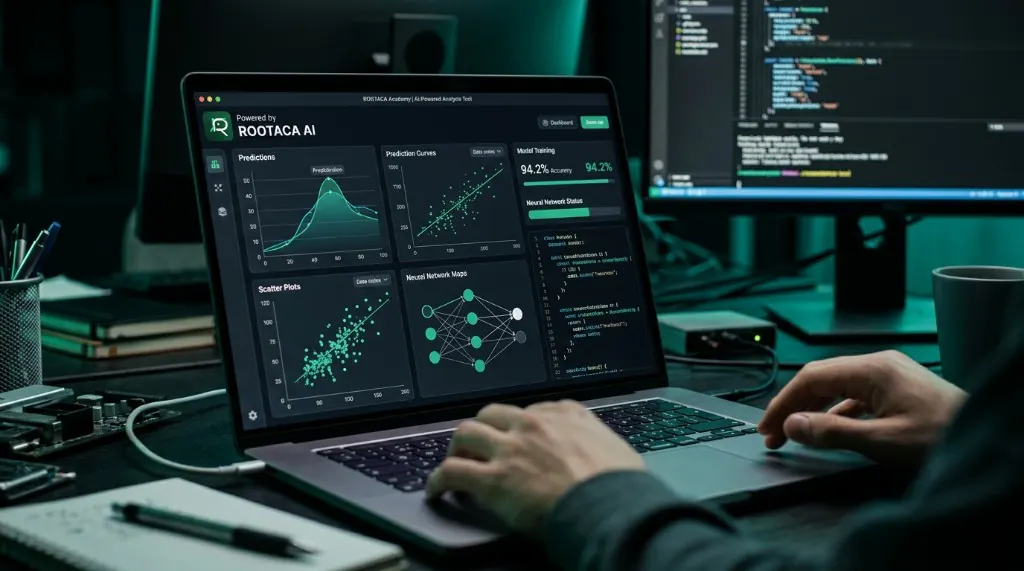
What an AI feature looks like inside a product
Smart Document Analysis
- ↓
User
Upload Document
- ↓
System
Process Data
- ↓
AI
Analyze
- ↓
Result
Extract useful information
Application
Display result
Behind the smart feature... a full system.
- UI
- Application Logic
- API
- AI
- Data
- User↓
- Frontend↓
- Backend / API↓
- AI Service↓
- Model↓
- Data
From the idea... to a smart feature.
01
Understand
We define the problem and the user need.
02
Collect
We gather the data that can help.
03
Prepare
We clean, explore, and shape the data.
04
Build
We train a suitable model.
05
Evaluate
We check whether the result is useful.
06
Integrate
We connect the result to an application.
07
Improve
We learn from errors and refine the feature.
In the end, you will be able to...
Use Python
Write and work with data and the basic tools.
Understand data
Read data and see its problems and patterns.
Build models
Apply models that fit different problems.
Evaluate results
Measure outcomes and understand errors.
Build AI features
Turn a model into a feature inside an application.
Think like a software engineer
See where AI sits in the system — not as something separate from the product.
At ROOTACA, we start with the problem.
Traditional Learning
Model → Code → Exercise
ROOTACA Approach
Problem → Data → Thinking → Model → Product
After you start here...
Software Development
To understand building systems and applications more broadly.
Web Development
If you want to build the interfaces and apps that use AI features.
Mobile Development
If you want to turn smart ideas into mobile experiences.
Programming Fundamentals
If you need to strengthen programming fundamentals first.
Questions about this path
Do I need to know Python?+
Python is a core part of the path. A programming foundation helps a lot before starting.
Is this path suitable for beginners?+
The path is classified as intermediate, so it is better to have programming fundamentals first.
Will we learn machine learning?+
Yes. Model concepts, training, and evaluation are introduced in a practical way at the level of this path.
Will we learn generative AI?+
This path does not center on generative AI. The focus is data, models, evaluation, and integrating results inside a software product.
Will we build a project?+
Yes. There is a student training project to apply data and AI and connect them to a product.
Is AI here only theoretical?+
No. The focus is application: data, models, and integration inside an application.
The data is there... the question is what you will build with it.
Start from the Root, understand the data, and build your first smart feature.